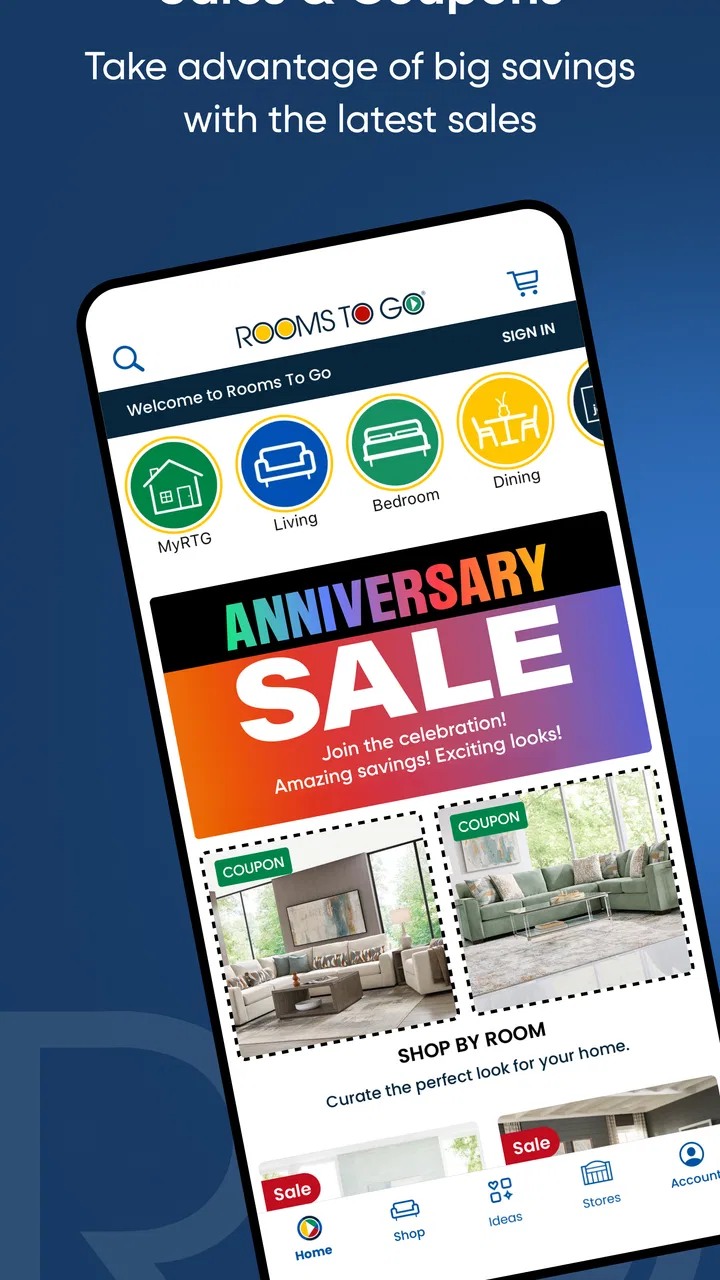
Rooms To Go
- 4.8
- Rating
- 1.00M
- Installs
- Free
- Price

 Analysis by App-foxy
Shopping for furniture on a phone can be surprisingly useful when you are trying to compare a room set, check a finish, or make a decision while standing in your living room. That is the role I found for Rooms To Go: it is a free shopping app from Roomstogo.Com, Inc. focused on browsing furniture and decorating ideas rather than acting like a general marketplace. I would recommend it to someone who already has a rough idea of the room they want to furnish and prefers a focused catalog over a noisy collection of unrelated sellers.
My overall impression is positive, but with an important qualification. The app makes product discovery convenient, yet a furniture purchase still deserves more care than an ordinary impulse buy. A phone screen can help me shortlist a sofa or bedroom collection, but it cannot replace checking dimensions, thinking through delivery access, or understanding the choices presented during checkout. The app is strongest as a planning and comparison tool; I would be more cautious about treating it as the only step before committing to a large purchase.
How the shopping experience builds confidence
Rooms To Go has been available since October 2, 2014, and its long presence gives the app a more established feel than a newly launched furniture browser. It is also widely used, with over one million installs, an average rating of 4.8, and around 5.6 thousand ratings. Those figures do not prove that every order will be smooth, but they do suggest that the app has become a familiar route into the retailer’s catalog rather than a short-lived experiment.
You May Also Like

 Blood Strike: 2.5 Anniversary
Blood Strike’s Loadouts Turn Every Drop Into a Tactical Gamble
A close look at Blood Strike’s custom loadouts: how fast access to signature weapons reshapes its battle royale rhythm, rewards preparation, and narrows the gap between fights.

 Pandora - Music & Podcasts
Pandora’s Music Is Easy to Start, but Harder to Recover
Pandora’s strength is its low-effort path from a seed to a station. Its weak spot is how much confidence it asks you to place in connection, setup, and quiet recovery.

 8 Ball Pool
 Is Built on Rivalries, Rematches, and Routine
A close look at the rivalries, rematches, shared routines, and unanswered safety questions that turn a quick pool match into a persistent mobile community.

 Samsung Music
’s Quiet Strength Is Playing What You Already Own
Its reach comes less from spectacle than from dependable access to a personal library. That simplicity is both the app’s strongest retention engine and its ceiling.

 AccuWeather: Weather Radar
AccuWeather Review: A Quick, Clear Forecast for Everyday Decisions
For everyday plans, the best forecast is the one you can understand quickly. AccuWeather makes rain timing, radar, and local conditions easy to act on, with a few trade-offs.

 Hill Climb Racing
Why Hill Climb Racing Still Turns Crashes Into One More Run
A tiny car, a bumpy hill and one more upgrade: Hill Climb Racing keeps resurfacing because its simple chaos makes every near-miss feel personal.
More From Our News Desk



I also appreciate that the developer is identified clearly as Roomstogo.Com, Inc. That matters when I am looking at expensive household items, because I want to know which retailer is behind the shopping experience. The app is rated for Everyone, costs nothing to install, and the current version is 9.1.0 for devices running operating system version 10 or newer. In practical terms, that makes it accessible to many shoppers, although anyone using an older device should check compatibility before planning around it.
The trust question is slightly different from the question of whether the app looks attractive. Furniture shopping involves personal preferences, household routines, and sometimes a substantial financial decision. I therefore pay attention to whether the app lets me make choices deliberately instead of pushing me rapidly from inspiration to purchase. The useful standard here is simple: can I browse at my own pace, inspect what I am considering, and stop before an irreversible step?
In my experience, the app makes the most sense when I use it as a private shortlist. I can look through styles, notice which collections belong together, and save mental notes about colors or proportions before discussing the decision with someone else. That is a better use than opening it with no plan and allowing attractive room photography to determine the entire design. Furniture images are persuasive, and a staged room can make a large piece appear less imposing than it will in a small apartment.
One practical habit improved my experience: I measured the available space before browsing seriously. I kept the width of the wall, the path from the entrance, and the position of doors in mind while comparing items. That changed the app from a source of tempting pictures into a useful filter. If you are furnishing a room after moving, take photos of the empty space first and keep them available while browsing. The visual reference helps you judge whether a style actually fits your home rather than only matching the app’s presentation.
What the app is good at during the first pass
The strongest early-stage use is narrowing a broad decorating problem into a manageable set of possibilities. Instead of searching the wider internet for every item separately, I can begin with the retailer’s own furniture selection and see how related pieces are presented together. That is especially helpful for someone who wants a coordinated room but does not feel confident combining a sofa, tables, storage, and accents independently.
This approach is different from using a general search engine. A general search gives me more variety and may expose independent shops, used furniture, and competing prices, but it also creates more work. Rooms To Go is more focused. The trade-off is that I gain a simpler path through one retailer’s selection while giving up some of the breadth and price comparison available elsewhere.
I would use the app in three passes. First, I would browse without trying to buy anything, simply identifying the styles that appeal to me. Second, I would return with measurements and compare only realistic candidates. Third, I would review the item details and the choices shown at the point of purchase. Separating inspiration from commitment is a small but valuable safeguard against ordering something because the room image looked convincing.
Another useful workflow is to involve a second person before checkout. For a sofa or bedroom set, I would send screenshots or show the product page to the person sharing the space. That conversation often reveals practical issues that the app cannot decide for me: whether the fabric suits pets, whether the color works in changing daylight, or whether the arrangement leaves enough room to move around. The app supports discovery, but household suitability remains a human judgment.
Controls and choices deserve attention
Because this is a shopping app, I would not judge trust only by how quickly it displays products. I would also look at the choices presented while I browse, create or use an account, and move toward an order. A careful shopper should notice whether signing in is optional at a particular stage, what information is requested, and whether the app makes it clear when browsing has become an actual purchase process.
I prefer to keep account decisions intentional. If I am only comparing furniture, I would avoid creating an account until I see a clear benefit in doing so. If an account is needed for a later step, I would use a password that is not reused elsewhere and would review the account controls after setup. I would also avoid storing payment information unless the convenience is genuinely worthwhile for my situation. These are not reasons to avoid the app; they are ways to keep control over a retail relationship.
The same principle applies to notifications and promotional communication. I would choose only the messages I actually want and revisit those choices if the app provides settings for them. A furniture retailer may have useful updates, but not every promotional reminder deserves permanent access to my attention. Turning off unnecessary alerts can make the app feel like a tool I use rather than a channel that constantly pulls me back.
When an app requests device access, I look for a clear connection between the permission and the action I am trying to perform. For example, access related to selecting a photo would make sense only when I choose a feature that needs a photo. I do not assume that a permission is harmless simply because the app is popular, and I do not assume that a request is inappropriate without reading the explanation. My rule is to grant access at the moment it is needed, review the operating system’s permission manager afterward, and remove access that no longer serves a purpose.
This is also where the app’s minimum operating-system requirement matters. Running a supported version is not merely about getting the newest interface. Updates can affect security fixes, compatibility, and the way account controls are presented. I would keep the phone’s system and the app current where possible, especially if I intend to sign in or complete a purchase through it.
Moments when personal information matters most
The most sensitive part of the experience is not casual browsing. It is the transition from looking at furniture to arranging a purchase. At that point, I slow down and read each screen rather than tapping through automatically. I check what information is being requested, whether delivery details are correct, and whether optional choices are visually separated from necessary ones.
Furniture orders can involve more than a simple shipping address, so I would be particularly careful with delivery-related information. I would enter only what is needed to make the order workable, verify apartment or unit details, and avoid assuming that a saved address is still correct. A mistake here is more disruptive than entering the wrong address for a small parcel, because large furniture requires planning and may be difficult to redirect.
I also treat payment screens as a pause point. Before confirming, I review the item, configuration, quantity, and total shown to me. If the app presents additional services or optional products, I want to understand whether they are selected by default and whether I can remove them. The visible choices at this stage matter more to me than a polished home screen, because this is where an accidental tap can have real consequences.
For shoppers who are uncomfortable entering personal details in a mobile app, the sensible alternative is to use the app for research and complete the decision through another official route that feels more comfortable. That may be a better fit for someone who wants to compare furniture on a phone but prefers a larger screen or direct conversation before ordering. The app does not need to be the entire shopping journey to be useful.
I would also avoid browsing or checking an order on a shared device without signing out afterward. This is basic advice, but furniture shopping often happens in family spaces where several people use the same tablet or phone. Keeping account access separate protects order details and prevents another person from accidentally changing a saved choice or viewing information that should remain private.
Where it beats alternatives, and where it does not
Compared with a general furniture marketplace, Rooms To Go offers a more controlled environment. That can reduce the effort of comparing items that belong to completely different sellers, but it also means I am seeing a narrower commercial selection. If my priority is a coordinated room from one retailer, the focused catalog is an advantage. If my priority is finding the lowest possible price, rare vintage pieces, custom dimensions, or local secondhand options, I would use other shopping methods as well.
Compared with a retailer’s website in a desktop browser, the app is more convenient for quick browsing from the sofa or while measuring a room. A larger browser window may still be better for comparing several pages, reading long details, or keeping multiple references open. I see the mobile app as the more comfortable option for discovery and the larger screen as potentially better for careful review. Neither approach removes the need to inspect the final choices.
Compared with visiting a physical showroom, the app is faster and less demanding. I can browse at odd hours and revisit a style without traveling. The showroom has the opposite strength: I can experience scale, texture, firmness, and color in person. For upholstered furniture especially, I would not let the convenience of the app make me forget what a screen cannot convey. If comfort and material feel are decisive, an in-person check or a clear return understanding becomes more important.
There is also a trade-off between convenience and independent verification. The app keeps me inside one retailer’s presentation, which is useful for consistency but can make comparison feel narrower. I would search for outside opinions about the specific product or retailer process when the purchase is significant, while remembering that online comments may describe different circumstances. The app is a starting point for an informed decision, not the only source I would trust.
Everyday scenarios where the app earns its place
Imagine that I have moved into a new apartment and need seating before guests arrive. I would first measure the living room, photograph the wall where the sofa will sit, and use the app to identify collections that fit the available width. I would then compare the likely candidates with the room photo, check whether the surrounding walking route remains usable, and show the shortlist to the person sharing the apartment. Only after that would I examine the purchase choices and delivery information.
Another realistic use is replacing one damaged piece without redesigning the entire room. I might use the app to look for a table or chair that sits comfortably beside furniture I already own. In that situation, color matching on a phone can be misleading, so I would compare the app’s images with a photo taken in my own lighting. I would also pay attention to height and depth, since a piece can look compatible while feeling awkward next to existing furniture.
The app is less suitable for someone who wants highly personalized design advice. It can help me see products and combinations, but I would not expect it to understand the quirks of my floor plan, accessibility needs, or long-term maintenance preferences without my own research. A professional designer, a showroom conversation, or a broader comparison process may be better when the room has unusual constraints.
I would also skip relying on it alone if I am shopping under a strict budget and need to compare every retailer. A free app can reduce browsing effort, but it does not automatically make a purchase economical. The right question is not whether the app is convenient; it is whether the convenience justifies staying within this particular retailer’s selection for the item I need.
My cautious recommendation
After using it as a furniture-browsing tool, I see Rooms To Go as a practical companion for planning a room, building a shortlist, and exploring coordinated pieces without leaving the phone. Its free access, Everyone age rating, established availability, and strong average rating make it approachable for ordinary shoppers. The developer, Roomstogo.Com, Inc., is clearly associated with the product, and the app has a substantial user base behind it.
My recommendation comes with a clear routine: browse first, measure second, verify the product and delivery choices third, and only then decide whether to sign in or complete the purchase. I would review permissions and account settings instead of accepting every prompt automatically, and I would keep optional communication under my control. The best way to use this app is as a deliberate shopping aid, not as a shortcut around careful furniture buying.
For someone furnishing a room with a coordinated look, I think it is worth trying. For someone seeking the broadest market, the cheapest possible deal, custom work, or the tactile reassurance of a showroom, it should be one option among several. I would install it when I want a focused way to explore the retailer’s furniture, but I would keep the final decision grounded in measurements, household needs, visible account choices, and a careful review before confirming anything.
FAQs for Rooms To Go
01What platforms is the Rooms To Go app available on?
The Rooms To Go app is available for both Android and iOS devices. You can download it from the Google Play Store or the Apple App Store, ensuring a seamless shopping experience on your smartphone or tablet, regardless of your preferred platform.
02Can I make purchases directly through the Rooms To Go app?
Yes, the Rooms To Go app allows you to browse and purchase furniture directly from your device. The app offers a secure and user-friendly checkout process, enabling you to complete your purchases with just a few taps. Payment methods include credit/debit cards and other popular digital payment options.
03Does the Rooms To Go app offer any exclusive discounts or promotions?
The Rooms To Go app often features exclusive discounts and promotions for app users. These deals can include special sales, limited-time offers, and notifications about upcoming promotions. Be sure to enable push notifications to stay informed about the latest discounts available through the app.
04Is there a virtual room planner available in the Rooms To Go app?
Yes, the Rooms To Go app includes a virtual room planner feature. This tool allows you to visualize how furniture will fit and look in your space. You can customize room dimensions, arrange furniture, and even experiment with different styles to ensure your chosen pieces complement your home perfectly.
05How does the app handle delivery and shipping information?
The Rooms To Go app provides detailed information on delivery options and shipping times. Once you've made a purchase, you can track your order status directly through the app. It also offers customer support for any delivery-related inquiries, ensuring a smooth and transparent shopping experience.
Pros
- User-friendly interface for easy navigation.
- Wide variety of furniture styles available.
- Convenient in-app purchase options.
- Clear product images and descriptions.
- Helpful customer service chat feature.
Cons
- Limited customization options for furniture.
- App occasionally crashes during checkout.
- Shipping details can be vague.
- Requires strong internet connection.
- Some items have delayed delivery times.

Rooms To Go
Gallery